
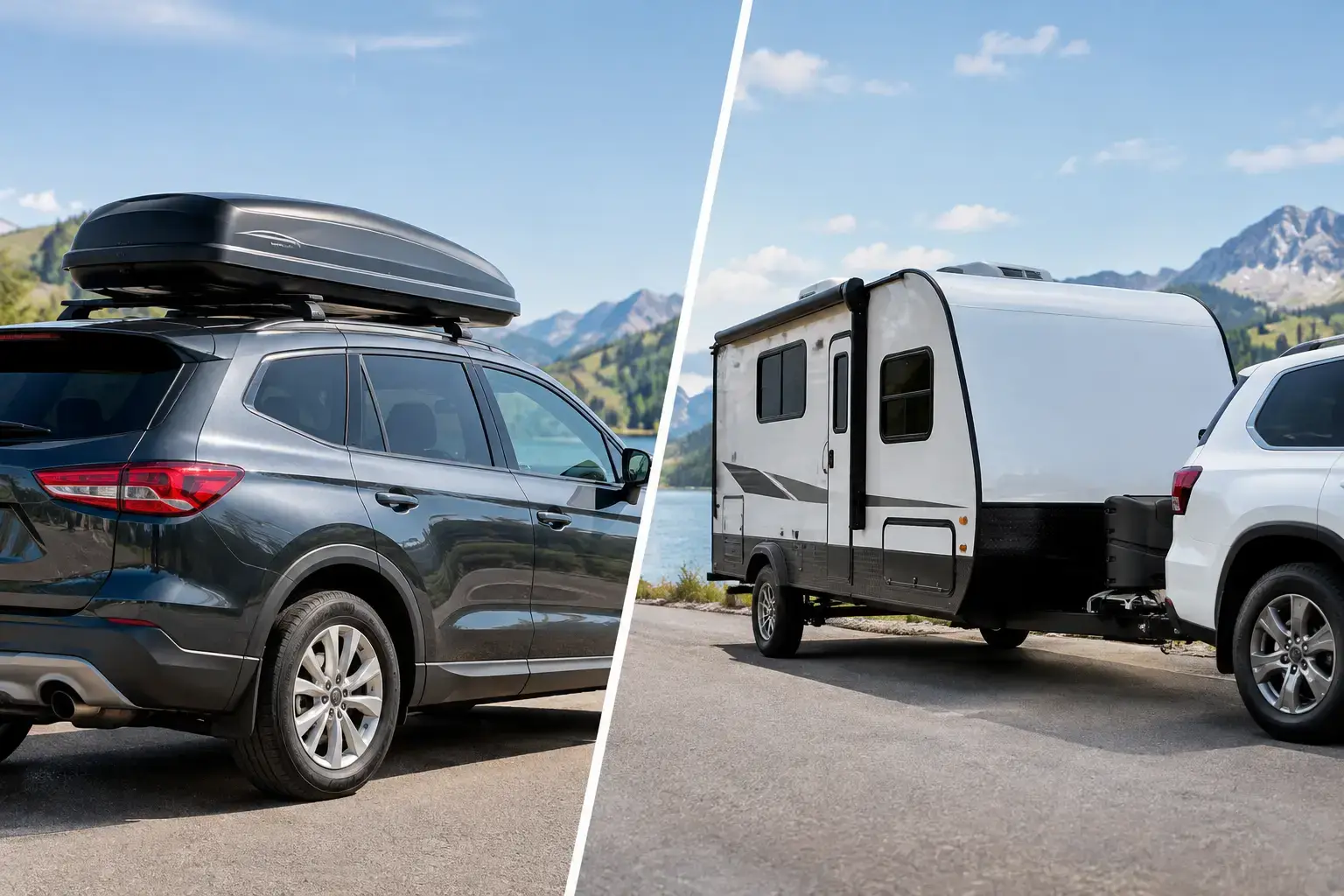
A packed family car on the way to a camping break can turn a two-hour drive into a cramped ordeal. Choosing between a roof box versus trailer is not simply about finding more room. It changes how your vehicle handles, what you can bring, where you store the equipment, and how easily you can set off on a Friday afternoon.
For many Irish drivers, a roof box is the quick, tidy answer for holiday luggage. A trailer offers far more flexibility when the load gets bulky, muddy or heavy. The right choice comes down to what you carry most often, not the biggest load you might carry once every few years.
Roof box versus trailer: the essential difference
A roof box carries luggage above your vehicle using compatible roof bars. It is enclosed, lockable and ideal for lighter, weather-sensitive items such as clothes, bedding, pushchairs, camping gear and sports equipment. Once fitted correctly, it is always with the car when you need it.
A trailer sits behind the vehicle and connects through the towbar. It can carry larger and heavier loads, from bikes and tents to garden waste, timber, tools and bulky camping equipment. Depending on its design, it may be open, covered or fully enclosed.
Neither option is automatically better. A roof box makes sense when convenience, secure dry storage and easy holiday packing matter most. A trailer is usually the more capable choice for regular large loads or jobs that would quickly overwhelm a roof box.
Choose a roof box when luggage is the main problem
A roof box is a strong option for families who run out of boot space before a weekend away. It keeps the cabin clearer, which is particularly welcome when children, pets and passengers are all competing for room. With your luggage overhead, you can still access the boot for coats, snacks and the items you need at each stop.
It also protects contents from rain, road spray and dirt. That is useful for camping trips, ferry crossings and trips where a damp tent or muddy boots would not be welcome inside the car. A lockable box adds a useful layer of security when the vehicle is parked, although valuables should never be left in any vehicle unattended.
There is less preparation than with towing. You do not need a towbar, trailer lights or a place to reverse a trailer into at home. For drivers who only need extra space a few times a year, this simplicity is often the deciding factor.
That said, roof boxes have firm limits. Their useful load is governed by the vehicle roof-load rating, the roof bars and the box itself. The lowest rated component sets the limit. A box may look large enough for several heavy suitcases, but loading it with dense, heavy items can exceed the roof limit surprisingly quickly.
Keep heavy equipment low in the car where possible. A roof box is best for bulky but relatively light gear: sleeping bags, coats, inflatable mattresses, children’s clothing and folding chairs. Pack evenly, secure the contents using the internal straps, and make sure the lid closes without force.
The driving trade-off
A roof box affects fuel use because it creates extra wind resistance. You may also notice more wind noise, especially on motorway journeys or in exposed conditions. The vehicle’s centre of gravity is raised, so take bends smoothly and allow for the extra height when entering car parks, hotel barriers, garages and ferries.
This height is one of the most common frustrations. Before leaving, measure the total vehicle height with the box fitted and keep it in mind. A low multi-storey car park can be a more immediate problem than the extra fuel cost.
Choose a trailer when the load is bigger, heavier or messier
A trailer earns its keep when the load is not just luggage. Garden materials, bulky furniture, bikes for a full family, building supplies, work equipment and camping gear can all be difficult to fit safely in a roof box or car boot. A trailer gives you a much larger, more adaptable carrying space.
For homeowners, it can also be useful beyond holidays. One weekend it may take green waste to a recycling centre; another, it can collect paving, timber or a new garden bench. Tradespeople and regular DIY users may find that flexibility far more valuable than an enclosed roof box.
An open trailer is practical for awkward loads but requires a proper cover and secure tie-downs when carrying items that could be affected by weather or blow out in transit. An enclosed trailer offers better protection and security, but it takes up more space and costs more to buy and maintain.
The biggest advantage is payload, but do not treat a trailer as unlimited capacity. Check the vehicle’s towing limit, the trailer’s maximum authorised mass, towbar rating and permitted noseweight. Weight should be distributed carefully, with the load secured so it cannot shift under braking or cornering. An overloaded or badly balanced trailer is unsafe and can make a journey stressful very quickly.
The towing trade-off
Towing requires more driver attention. You need extra room for turning, more distance for braking and more care when changing lanes. Reversing takes practice, and narrow driveways, busy petrol stations and tight holiday accommodation can feel much less convenient with a trailer attached.
There are practical checks too. Lights, tyres, wheel bearings, coupling condition and safety equipment all need regular attention. Before buying, confirm what your driving licence allows you to tow and make sure the trailer is properly insured where required. Requirements can vary by vehicle, trailer weight and licence category, so check current rules before setting off.
Storage is another real consideration. A roof box can often be lifted onto wall brackets or ceiling storage in a garage. A trailer needs a secure parking space, and even a compact model occupies valuable driveway or side-garden room. If space at home is tight, this alone may settle the decision.
Compare the cost beyond the purchase price
A roof box needs compatible roof bars, and fitting matters. The initial outlay can be worthwhile if you expect years of family holidays, but choose a size that suits the vehicle rather than buying the biggest box available. An overlong box can interfere with hatch opening, while a wide model may be awkward to load on a tall SUV.
A trailer may seem better value per litre of carrying space, particularly if you use it for home projects as well as travel. However, factor in the towbar if you do not already have one, plus a cover or secure enclosure, servicing, tyres and storage. The actual cost depends on how often it comes out of the driveway.
Fuel is worth considering in both cases. A roof box creates aerodynamic drag, while a trailer adds rolling resistance and drag, especially at speed. Neither makes a vehicle more economical. If your trips are mainly long motorway journeys with light luggage, a streamlined roof box may be easier to live with. If you are transporting bulky loads that would otherwise require several journeys, the trailer may still be the more efficient practical option.
Capacity is not the only measure of convenience
Think through your typical loading day. If you can pack everything in bags and lift it onto the roof safely, a roof box keeps the process straightforward. It is often ideal for family holidays where the main requirement is dry, orderly luggage space.
If your gear is dirty, rigid, oversized or genuinely heavy, a trailer avoids the awkward lifting and keeps the car cleaner. It can also free the roof for other accessories, although every item still needs to be compatible with your vehicle and fitted correctly.
There is a middle ground for some drivers. A roof box can handle annual holidays while a local trailer hire option covers the occasional large collection or garden project. That approach avoids buying and storing equipment for a job that only appears once or twice a year.
A practical checklist before you buy
Start with the vehicle rather than the accessory. Check your handbook for roof-load and towing limits, then confirm roof-bar compatibility or towbar specifications. Measure your available storage space at home, including access through gates and around the driveway.
Next, be honest about your normal load. If it is clothing, bedding and camping kit, choose a roof box with enough length and volume for those items. If it is tools, bicycles, timber, garden materials or heavy equipment, investigate a trailer with a suitable payload and secure loading options.
Finally, consider who will use it. A roof box should be possible to load safely, while a trailer should be manageable for the person most likely to tow, park and maintain it. Getting the right fit at the start is far better than adapting to an accessory that makes every trip harder.
Coola Living can help make sense of roof box sizes, roof-rack fitment and practical transport accessories before you commit. Choose the option that suits the journeys and jobs you actually do, then pack within the limits and enjoy the extra space rather than worrying about it.
Discover more from Coola Living Ireland
Subscribe to get the latest posts sent to your email.